03 - How It Works · Deep dive
A hard glass is not a still glass.
Dry a medicine the right way and it ends up sealed inside a glass. That much is settled science. The open question is what makes one glass protect better than another, and the answer is not the number the industry measures. Here is the mechanism, start to finish.
1. What Drying Does
What drying actually does.
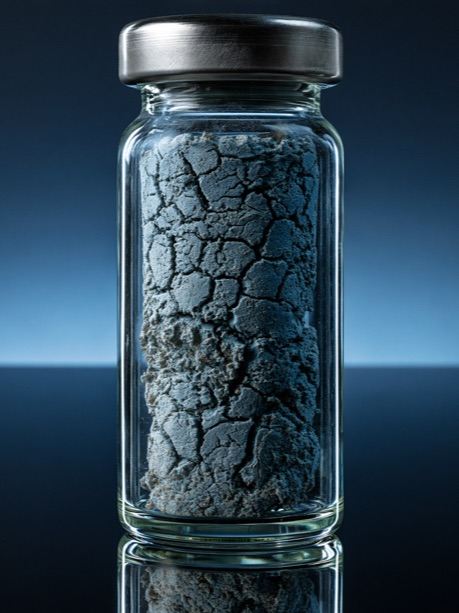
Remove water from the right mixture and the molecules never get the chance to form crystals. They jam, mid-shuffle, into a disordered solid. That is a glass, in the same physical sense as window glass, and whatever is trapped inside is held in place.
- It has to reverse. Add water and the glass dissolves, releasing the medicine as it went in. The protection has to disappear on demand.
- Today that glass is sugar. Freeze-drying alongside trehalose or sucrose is standard practice, and it works.
- But a sugar cannot be designed. You cannot specify how it behaves or tune it to the medicine it is carrying. A protein you can.
2. Why It Protects
The protection is the stillness.
A medicine goes bad because its molecules move. They unfold, they clump together, they react. Every one of those failures requires motion. Take the motion away and none of them can happen, which is the entire reason a glass protects anything at all.
So the useful question is not whether the medicine is in a solid. It is how completely the motion has actually stopped. That is what the rest of this page is about, and it is where our approach parts company with standard practice.
3. Solid Is Not Still
Solid does not mean still.
The industry measures one number: the temperature at which the glass softens back toward a liquid. Keep the product below it and the glass holds. It is a real constraint and it is genuinely useful. It is also where most of the thinking stops.
- Below that temperature the glass is solid, but it is not motionless.
- Atoms still rattle in place. Side chains still flip. Far too fast to see, far too small to soften the solid.
- None of that shows up in the softening temperature. Two glasses can match on that number exactly and rattle at completely different rates.
- Which means the standard number tells you when the glass melts. It does not tell you how still it is.
Some additives make the standard number worse and the medicine survives better anyway. They damp the fast rattling even as they soften the glass. If the standard number were what protects the medicine, this could not happen.
Schematic. The directions are what the published work reports. The magnitudes are illustrative.
4. Two Glasses, Same Number
Two glasses, same number, different outcome.
Here is that difference made visible. Both panels hold the same medicine. Both soften at exactly the same temperature, so the standard measurement calls them identical. The only thing that differs is how much of the fast rattling survives inside. Run the clock.
Schematic. It illustrates our hypothesis, not measured results. Residual water is included because water softens a glass and speeds the motion inside it, which is why moisture is measured alongside the softening temperature.
5. Why It Adds Up
Why a rattle that small matters.
A single rattle does nothing. The problem is how many of them there are. Molecular motion and shelf life sit nineteen orders of magnitude apart, so damage never arrives as one event. It accumulates from countless small ones. Select a point on the scale.
Stretch one picosecond into a single second, and a two-year shelf life becomes two trillion years. More than a hundred times the age of the universe.
You cannot watch a vial for two years before shipping it. You can build a glass in which the fast motions that feed the slow damage are suppressed from the start. That is what we design.
6. The Short Version
Water leaves. A glass forms. Motion stops. The medicine keeps. Add water and it comes back.
What we have not shown yet is that our own proteins do this well enough to matter. Those measurements are running now in a leading academic lab.