02 - The Insight · Deep dive
Nature already solved this.
Life has been shipping fragile molecules through total dryness for hundreds of millions of years. A handful of organisms can lose almost all their water, sit dormant for years, and spring back the moment water returns. They survive by turning themselves to glass. We took that idea and learned to engineer it on demand.
Convergent evolution
The same trick, discovered again and again.
Surviving total drying did not evolve once. It appeared independently across the tree of life, in animals, plants, fungi, and microbes that never shared the ability. When evolution lands on the same answer that many separate times, the answer is not a fluke. It is physics. Select a survivor to see how it does it.
Every one of them converges on the same mechanism: as the water leaves, it is replaced by a stable biological glass, and molecular motion inside nearly stops. That is vitrification, and it is the physics Still Velocity designs around.
What convergence means
Many roads to the same physics.
The interesting part is not that these organisms survive drying. It is what their independence tells you about the problem.
Evolution did not find one answer eight times. It found eight ways into the same answer.
What it adds up to
Why the tardigrade, and why we don't copy it.
Every survivor on that wheel solved the same problem. One of them is the right place to start, and even then, not by copying it.
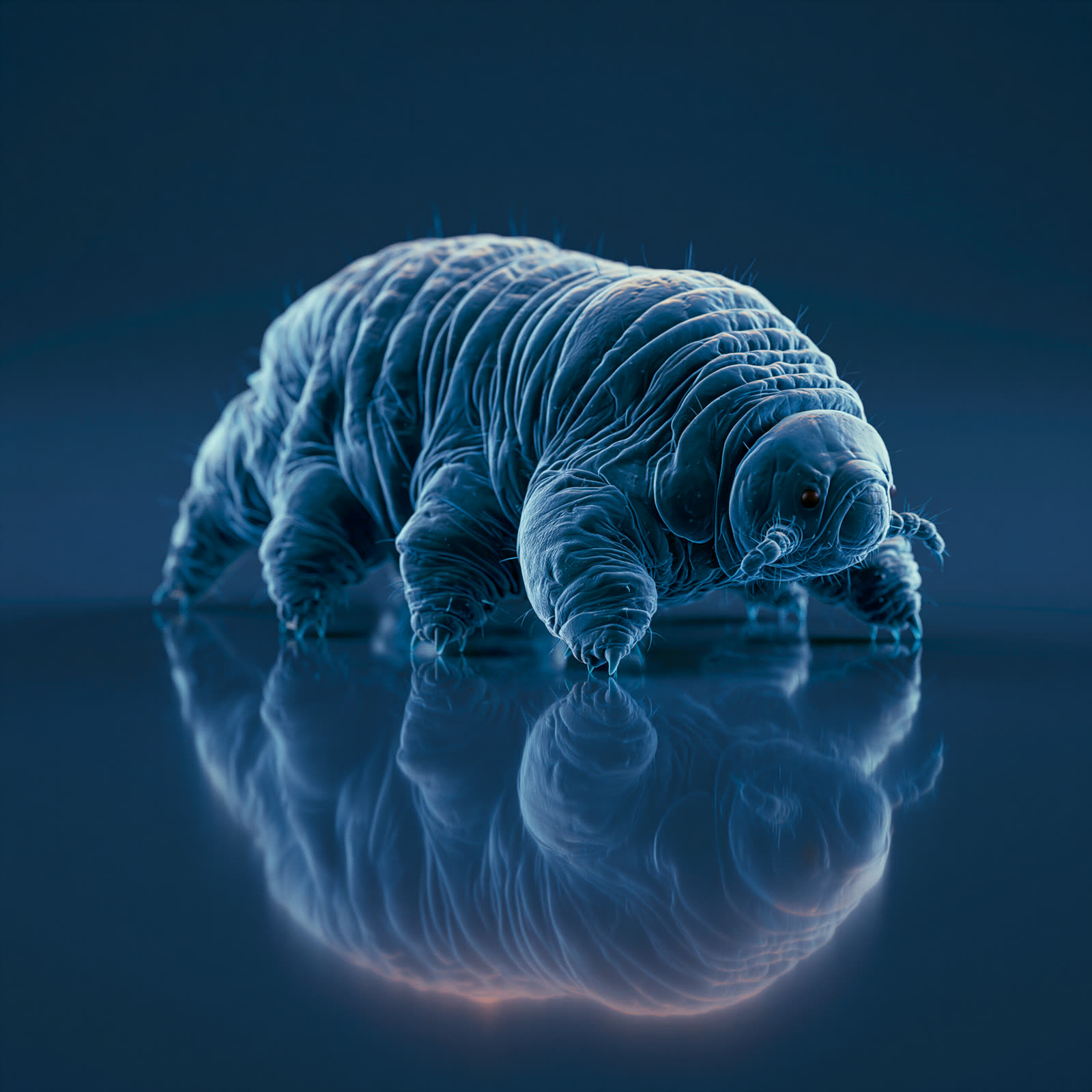
A tardigrade protein was built to protect a tardigrade, not a vaccine or a clotting factor. Others already have claims on the natural ones. And a copy is only ever as good as what you copied. So we design our own, on the same physics, shaped around the medicine it has to carry.
Evolution found this answer again and again. We are designing it on purpose.